
Natural Hair & Nursing?


Natural hair and nursing……..do they clash do they agree? Hmmm

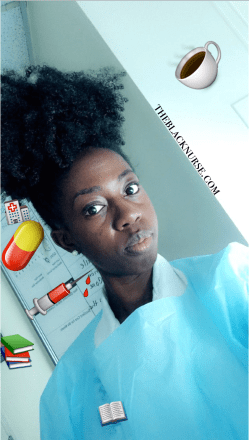
If you didn’t know I am a woman of color, specifically Haitian-American. I’ve been natural, as in no chemicals and relaxer free, for a little over 3 years now. I have very thick, dense, coarse, and kinky hair. Right now if I stretch my hair it reaches my bra strap. I absolutely love my hair. I enjoy being natural and I’m comfortable in my skin. However, being natural and being a nursing student has proven to be somewhat of a challenge.

Screen Shot 2016-07-27 at 12.25.11 AM
Freshly washed and conditioned. 


First and foremost, my hair is massive. Literally. It’s like walking around with a soft, black cloud around my head. I also happen to live in a very humid environment so straightening or blowing my hair out is not an option because my hair would swell up as swoon as I walk outside. For nursing school I prefer to have my hair up and away. I don’t want to fiddle with my hair in class and especially when I’m in clinicals. The problem I have is that my hair is so massive putting it into a bun is easier said than done. My buns look odd because my hair is so thick similar to helmet head. And if I attempt to wear my hair in a puff, the puff is so massive it’s almost obscene. I get stares and sometimes I’m a little embarrassed because I’m not sure if it’s appropriate enough for the work place. Once I had a clinical instructor tell me to go “calm down my hair” while at the hospital. What she didn’t know what that was about as tamed as my hair got. I still went in the bathroom and attempted to try to pack in my puff but there is only so much I can do. Luckily the charge nurse for the floor we were on that day happened to be a fellow natural and she complimented my hair that day. After that I wasn’t as discouraged or embarrassed to wear my hair out.

In addition, washing my hair is an all day affair from start to finish. Because my hair is so kinky and coarse it constantly needs moisture and TLC. My hair is like needy friend that keeps calling to hang out. With nursing school, I don’t have entire days to spare jumping in and out of the shower and detangling or deep conditioning.

So how have I managed? 3 things

1. Protective Styling

I’ve been in nursing school for almost 7 months and out of 7 months I’ve probably worn my hair out for one solid month. I make it a point to keep my hair braided or twisted. It prevents me from over-manipulating my hair which can cause breakage, I can keep my hair in cute buns that are extremely low maintenance, and I can get out of the house quickly which is so important when I am waking up at 5am frequently.

2. Lots and lots of headbands

Like I said, my buns can look quite odd but slapping on a cute headband makes my buns looks semi-normal/cute. Again this is great because I have to get up so early most days and I also get to protect the edges of my hair. I probably rotate 5 different black headbands for school.

3. Moisture spritzes

My hair is constantly braided up so to maintain the moisture balance I mist my hair with sprays that contain oils. My favorite spray at the moment is Shea Moisture’s Coconut & Hibiscus Hold & Shine Moisture Mist. But I’ve made my own sprays using simple ingredients I have at home. I spray my hair in the morning and at night before bed. I still wash my hair and condition regularly but the mist really helps those weeks when I have 3 or 4 exams.

Overall natural hair and nursing are definitely doable. It can be frustrating but come up with a system that works for you and benefits your hair. Protective styling and low maintenance hair styles just happen to work for me and I’ve been able to retain a lot of length this year by just keeping my hair braided up. I plan on continuing this until the conclusion of my program. If you can any questions or want to know more about my hair care regimen please comment below or hit me up on social media. until next time, see ya!
Screen Shot 2016-07-27 at 12.21.41 AM
This is as subdued as my puffs get.

Federal Loans

I’m my previous post I talked about how I paid for nursing school and to really understand how things happen for me they way they did you need to understand federal loans, specifically subsidized and unsubsidized loans. I’ve decided to just make a separate blog post about so my previous blog post wouldn’t get to lengthy. So let’s get into it!

Federal Subsidized Loans

This a type of loan given out by the government to students pursuing higher education at a competitively low-interest rate. The loan normally lasts about 4 years (it does vary) and repayment begins 6 months after your after graduation date. The beauty about this loan is that you as the loanee pays no interest! The federal government pays the interest for you until you graduate.These are the BEST type of student loans offered.

Subsidized Loan Scenario: Let’s say I borrowed $100 from the government and the interest rate was 10%. $100 x 0.10 renders $1. So every month, assuming you aren’t paying anything pack yet, $1 worth of interest would be added to my original bill of $100. At the end of one year I would owe the government $12 ($1 for every month) in interest in addition to the original loan amount of $100 for a grand total of $112. With a subsidized loan, after one year I would only owe the government $100 because the interest of $12 was paid by the government for me.

Federal Unsubsidized Loans

This a type of loan is again given out by the government to students pursuing higher education at a competitively low-interest rate.  The loan normally lasts about 4 years (it does vary) and repayment begins 6 months after your after graduation date. What differentiates subsidized from unsubsidized loans is that the government does not pay the interest for you. Unsubsidized loans begin accruing interest the moment the loan is processed and that interest will keep accruing. This how someone can take a $10,000 loan out at end up paying well over $20,000 back in the long run. Interest can sneak up on you so be careful!

Unsubsidized Loan Scenario: So I borrowed the same $100 from the government and the interest rate was 10% but this time it’s an unsubsidized loan. $100 x 0.10 renders $1. So every month $1 worth of interest would be added to my original bill of $100. At the end of one year I would owe the government $12 ($1 for every month) in interest in addition to the original loan amount of $100 for a grand total of $112. With an unsubsidized loan, after one year I would owe the government $112 because the isn’t paying the interest for me.


These are really watered down examples of how this works. $12 may not seem like  a whole lot to pay back. But what if I had a $5,000 unsubsidized loan at a 4% interest rate? That means every month $200 in interest would be added to my total bill and in one year I would go from owing $5000 to $7,400! That’s a huge difference! And if you read my ADN vs BSN blog post you know that a deciding factor when I was choosing a nursing program was cost.

Now that you know all this information, you might ask well why doesn’t everyone just take out subsidized loans for whatever amount is needed? The simple answer is that your lender AKA the government wouldn’t make any money and this is all a business at the end of the day. The government puts a cap on the amount a student can request for subsidized loans per semester depending on what year the student is in.

Here’s another example….

Let’s say, hypothetically, I am attending a 2 year nursing program and the tuition is $5000 a year and of course I need federal loans to pay for school. The first year I take out a $10,000 loan. The government will only give me $3500 in subsidized loans for the first year and if I can’t come up with the additional $6500 from another source, that’s $6500 in unsubsidized loans. The second year I take out another $10,000. But as a second year the government will let $4500 out of the $10,000 be in subsidized loans. But again, that’s still $5,500 in unsubsidized loans.

The $6500 starts accruing interest the moment it is processed. So for 2 years while I am in school that $6500 bill is slowly growing. If the interest rate is 4% that’s an extra $260 being added to the bill every month for 2 years or 24 months. At the end of the two years, I’ve graduated from nursing school but my original $6500 bill nearly doubled into a final bill of $12,480 in addition to the $3500. In total, I went from owing $10,000 for the first year of the program to owing $15,980 for the first year.

For the second year that $5500 at the same interest rate of 4% will cost me $220 every month for 12 month. At the end of that final year of school my loan went from $5500 to $8140 and I still owe $4500 in subsidized loans. So my total second year of nursing school went from $10,000 to $12,640. So I might have thought my nursing school program was only going to cost me $20,000 when in reality I will end of owing at least $28,620!!! That’s almost an additional $10,000 in interest alone. This is how people end of spending the rest of their lives paying off student loans.

Below is a chart explaining in-depth how subsidized and unsubsidized loans are capped for every school year.

Screen Shot 2016-07-20 at 10.38.18 AM

Now student loans are a necessary evil. I do believe that the system is flawed but I also believe in investing in yourself and your education. And if I had to take out loans to go to school I would do it but if I can avoid it I will try my hardest. I hoped this article helped someone out there thinking about pursing higher education. Until next time, see ya!

How I’m Paying for Nursing School

As soon as I got into nursing school I immediately started to think about the financial implications of going back to school full-time. This was a one year accelerated program and it was strongly recommended that we cease working so I quit my job. The job that I was working at was Monday through Saturday from 9am to 6pm so even if I wanted to continue working there would be no way because I had class Monday to Friday from about 8 to 4pm. I was going to go from a steady paycheck to nothing for an entire year at minimum.

If you read my ADN vs BSN blog post you know that a deciding factor when I was choosing a nursing program was cost. My nursing program cost roughly about $10,000 and that figure included tuition, books, uniform, and equipment.  I didn’t have that kind of money stashed away and no one in my family was in any position remotely to help me with this financial burden. In fact I was regularly helping my family members while I was working. Luckily I had about $1,000 saved up from working and I decided that this would have to be my emergency fund for the duration of this program. I knew the days of getting my hair and nails done, random shopping sprees, and randomly dining out were over. I went back to doing my own hair and nails, I bring a lunch everyday, and I rarely eat out. Even with all of this it is still a financial struggle for me. But I’ve managed this far. But how have I managed?

Loans

I knew I needed to apply for a loan to pay for the program. Like I said $10,000 is a lot of money for me. Thankfully I stayed in state for my undergraduate education and in high school I also received a 4 year scholarship so I graduated debt free from undergrad. Because of that I hadn’t really utilized my supply of federal subsidized loans so I was planning to finally tap into that reserve to pay for school. If you want more information about federal loans the differences between subsidized and unsubsidized loans check out my next blog post.

At the school I attend you have to apply for financial aid in advance. The mistake I made was that I didn’t inquire about loans until after school had started. I was told I had to wait until everyone who applied for financial aid before me to be processed. After that my application would be processed. But students at my school had applied in August of 2015 for financial aid for January of 2016 so I was 4 months behind. basically I was all the way at the end of the line and I wouldn’t be receiving any funds of any sort any time soon. I ended up paying for my first semester with a credit card which I’ll speak more about in my next point.

Luckily, I am only attending a one year program so I knew that I wouldn’t need loans for an extended period of time and I wouldn’t need more than $10,000. In addition to that, my lender treats my loan as if I am receiving a 4 year degree even though I am in a one year accelerated program. So I’ll be graduating in December of 2016 but I won’t be required to pay back any of my loans until Spring of 2020 interest free! This is wonderful because I know I’ll be entering the work force within the next year and I’ll be able to pay off the entire loan before my repayment date.

So what really worked in my favor was that I still had federal subsidized loans available and my lendor is giving me 4 years interest free until I have to begin repayment. However, because I waited so late to apply for financial aid I was told I wouldn’t be receiving any loan money until the summer time. I was told this in February and the summer time was a looooong ways away. So how did I manage my finances for 7 months with no job?


Credit Cards

I knew that starting a program like this might incur various costs and I didn’t really have cash to pay for everything. I have a decent credit score and I always paid my bills on time. So I opted to open up a new credit card with a $10,000 limit and 0% interest for 15 months. I already had two other credit cards but they had lower limits and were no longer interest free. I also made sure to pay those credit cards off before starting school to avoid issues in the future. Opening a new credit card seemed like the best choice for me and it was probably one of the single best financial decisions I made. This card is basically how I paid for my tuition, books, uniform, incidentals, gas, and everything else until my loan funds disbursed. I know credit cards aren’t for everyone but I’m pretty disciplined and it has worked for me. My plan is to take out $4,500 in subsidized loans in the fall to hold onto in the event that my credit card bill gets too high for me to pay off by the time the 0% interest period is over. That way I can pay off my credit card and still owe no interest until 2020. Hopefully I’ll obtain a job and be able to pay off all my debts within a year or two.

So that’s how I paying for nursing school right? But wait there’s more….

Scholarships

Scholarships are the best. Really. Free money, you can’t ask for anything better. So from January to May, I was still living this broke life patiently waiting for my loan funds to disburse and racking up debt on my credit card. But in mid-May a huge blessing fell into my lap. I was basically offered a $9,000 scholarship for my nursing program. The crazy this is that I hadn’t applied for it either. It was a departmental scholarship where the students were chosen by administrators in the nursing department to receive this scholarship. I was elated. Now I’m basically going to school for free. I feel so blessed and I am so humbled. It’s been two months since I got that email but I am still in awe. After I got that news I knew as soon as the funds from my loan were disbursed I would immediately pay them as well as portion of my credit card debt. But this is my story and this is how things worked out in my favor.

If you are the person reading this blog still trying to figure out what you are going to do financially keep pushing and keep believing. I prayed on my financial situation and God didn’t disappoint. So I want you to keep believing and know that you are choosing an AMAZING career path. You’ll face struggles but it will be more than worth it in the end. I hope this story helped someone out there. If you have any questions please comment below. Until next time, see ya!

Dating in Nursing School

If you’re reading this post most likely you’re a nursing student or a pre-nursing student wanting more information about how to navigate relationships while simultaneously getting through the beast that is nursing school. I’m here to tell you it’s doable but it won’t be easy. A lot of my classmates are married, in long-term relationships, and there is even one couple that is doing the program together. All this to say that again it’s possible to succeed.

At the beginning of my nursing program I was in a long-term relationship with a man I thought I was going to marry. I was thinking about our future together, the type of home we would buy, what our children would look like, the works. We had been seriously dating for three years and I knew going into my nursing program that this program would test our relationship. Would would sink or we would swim and I so badly wanted us to swim. We had prior issues before I started school and this is important to note because it effected why things happened the way they did. So like I said, this program was going to determine if we sank or swim as a couple. Unfortunately, we sank. Two months into the program, I called it quits. He was my first love and I always thought making a choice to split up would be devastating. I expected depression and anguish. Long afternoons watching Law & Order SVU while eating strawberry cheesecake Ben & Jerry’s. I thought it would be the same awful experience I had helped some of my best friends get through. But I was fine. I was better than fine, I was stress free. I could think clearer and a weight was lifted.

Nursing school magnified and compounded all the issues in our relationship and because I was so busy and under so much stress I knew I was better off alone focusing on school than in a relationship that just added more stress. He and I had communication issues before the program and nursing school made our issues worse. But I’m not sad about what happened. I’m a firm believer that everything happens for a reason. If he and I were meant to be than we would be together. And us splitting apart while I was in the program was a blessing in disguise. Maybe if I hadn’t been so busy I would have devoted more energy to being sad. But the fact is I didn’t have time to be sad. I barely had time to grieve. I had chapters to read and exams to prepare for. I was way too busy to spend a lot of time being sad about a failed relationship. These distractions helped me get through that tough time and for that I am grateful for nursing school.

I’m no relationship expert but I’ll offer some advice and how to navigate dating and nursing school as best as I can from my experiences.

1. Speak with your partner in-depth about what the upcoming months or years are going to be like.

Things are going to change. If you’re a couple that generally spends a lot of time together than those moments might be cut back. If you’re a couple that doesn’t get to spend as much time together, nursing school can compound that tissue. Communicating what is about to happen can prevent confusion and frustration. Communication also brings me to my next point.

2. Ask yourself what you will need from your partner during this time.

Maybe you want more space. Maybe you want less space. Maybe you want you partner to let you vent and listen to your frustrations or maybe you want your partner to tell you to suck it up and keep pushing. Maybe you need your partner to support you and keep you grounded financially or spiritually or emotionally. And this goes both ways. Everyone needs to communicate what they expect from each other. Letting your expectations be known can make this transition smoother. Starting my nursing program I was looking for my partner to support me emotionally. Don’t get me wrong, he tried, but he struggled to understand the amount of stress I was under. The stress of nursing school is really something only other nursing students can really understand. I don’t think I effectively communicated how I need him emotionally and what I expected. I just thought things would fall into place.

3. Make time for each other.

Nursing school is hard and being a nurse will be very rewarding at the end. However, don’t let this be at the expense of losing your partner. I know it will be hard but carving out time for each other is absolutely necessary. Plan a date night or a monthly staycation, whatever it takes.

4. Include your partner in this journey.

Even though your going through this difficult time in your education, your partner is also going through a transition. They may not fully understand what you experience but it’s unfair to shut them out because they may not understand. So if they ask you how your day went tell them. Tell them you did your first wound vac, if you were covered in amniotic fluid, when started your first IV, or fed someone oatmeal. Make them feel included. There on this journey with you.


These are things I knew before starting this program but I didn’t really implement like I should have.Although my relationship didn’t work out I’m glad it happened when it did. Like I said before I do believe every that occurred with my relationship happened for a reason. The biggest thing is communication and transparency. I hope I could help some out there. Don’t make the same mistakes I did. I’ll make a separate blog post about gaining/maintaining/losing friendships while in nursing school. Until next time, see ya!

The Basics of My Nursing Program

So I’ve already published a few articles and I realized that I haven’t explained some important basic information about my nursing program so that if anyone is out there reading my blog posts they can understand what I mean when I throw around numbers and terminology.


81c165c5bb76423f14c258388a86c82a


Gone are the days where a 90 was still an A. Grading scales like this are why people say be prepared not to get A’s in nursing school. So how are grades calculated?

Thankfully, my school does round-up but only by 0.50. For example if I received a 76.6 as a final grade, the grade would be rounded up to a 77 which is considered passing. However, if the final grade was a 76.4 that would be a failing grade. Our grades are also calculated on a points system meaning if I get 95 on an exam which is an A, I wouldn’t get full credit as in getting a 100 on the exam. I would get a 95 exactly and that is the number that would be factored into my final grade.

Grading Scale for Courses:

93-100% A     [Passing]

85-92% B     [Passing]

77-84% C     [Passing]

69-76% D     [Failing]

Below 69% F     [Failing]


The dreaded HESI. What is the HESI?

The HESI (Health Education Systems, Inc.) is a computerized exam designed to assess prospective students entering the health science fields. In my blog posts I’ll be discussing the HESI in relation to nursing. HESI exams are not specific to any one nursing program. What that means is that the HESI may or may not cover topics that my program didn’t cover or include in the curriculum. Scary right? The HESI is used to prepare students for the NCLEX. For my program, I must take and pass 7 HESI exams in the following courses:

Fundamentals of Nursing

Pharmacology

Pediatric Nursing

Obstetrical Nursing

Psychiatric Nursing

Medical-Surgical Nursing

Exit Exam

I take each of the HESI specialty exams and the conclusion of the course. For my program, the HESI is worth a whopping 15% of the course grade for every course so it is something I have to take very seriously. Not scoring on the HESI  can severely affect my grade and cause me to fail a course. At the conclusion of this program, every student is required to take a HESI Exit Exam. In a nutshell it’s a mini NCLEX that reviews all the material taught in nursing school and is a good indicator of how prepared a student is for the NCLEX. In my program you have to pass the exit HESI to graduate and to have the school submit your name to be able to sit for the NCLEX.

You can score anywhere from 0 to 1500 on the HESI. To pass the HESI within my program you need a 750 or greater. If I score 850 or above that basically means I know the subject well and I’ll get the full 15% factored into my grade. If I score between 849 and 800 that means I’ve grasped most of the necessary topics so I would only get 11% out of the 15% factored into my grade. If I score between 750 and 799 that means I’ve grasped the minimum necessary topics so I would only get 7.5% out of the 15% factored into my grade.

Grading Scale for the HESI:

850 or above = 15% 

800 to 849 = 11%   

750-799 = 7.5% 

749 or below = 0% 

I hope I was able to clarify any confusion. If you have any comments or you’d like to hear more about my experience with the HESI (I’ve taken 3 HESI exams thus far) just comment below and I’ll make a post about it.

OB Exam #1: Friend or Foe?

Screen Shot 2016-05-30 at 6.45.53 AM

So if you read my previous blog post you know that I had my first OB exam last Friday, July 15th. I was SO nervous before the exam. I never really know what to expect when taking exams with new professors. No amount of preparation can ever make me feel 100% confident.

I’m happy to report that the exam went very well 😁. At least that’s how I felt walking out. A lot of the questions that I made up to study with were extremely helpful and a lot of the content I focused on was on the exam. Now that I know how my professor words her exams I don’t feel as nervous for the next exam.

The nursing school I attend has had issues in the past with cheating so when we take any exams we cannot have any of our belonging with or near us. Our bags are placed in the front of the room, we cannot wear a jacket, and we cannot wear a watch. We are not even allow to have water with us. And it’s the same when we review our exams. Almost all of the exams are scantron based and we usually have to wait about a week to get our results which are given to us on paper. So basically, there isn’t much utilization of computers outside of powerpoints for lecture. I’m sure this is because of the cheating issues and that most of my professors aren’t the most tech savvy so they prefer gold ol’ paper and pencil. Anyways, I could not sit still while I was waiting to get my results back at the end of class yesterday. But what did I get on the test…..??

I got an A 😭🙏🏾. A 93.75 to be exact. Such a huge sigh of relief. That exam was worth 25% of the total grade for this course and I’m so humbled that I was able to start strong. Don’t get it twisted, by no means am I the perfect student. I’ve bombed my fair share of exams and had to pick myself up off the ground but it is so gratifying to see your hard work manifest itself academically. I don’t have much time to celebrate because I have another exam this Friday, July 22, which is also worth 25% of the total grade. Oh and it’s also my birthday 😑. So I’ll be bringing in my 24th birthday studying. But that’s okay with me. I’ll be celebrating my birthday after this class concludes and I like I mentioned in the ADN vs BSN blog post, I’m okay with sacrificing birthday festivities to do well in this program. In addition to this exam on Friday, I have my final and the HESI on Monday, July 25th, and after that I’ll be finished with OB and my second semester of nursing school. Right now I’m surprisingly calm seeing as I’m about to be lounging in hell for the next week. But I’ve made a study plan and I’ll keep praying and giving my anxiety and fears to God. So that’s my first update with OB. I really hope to keep this momentum moving forward. Until next time, see ya!

Oh and if you aren’t sure what the HESI is or the how grades are calculated at my nursing school check out this blog post.

Losing Classmates in Nursing School

failing

Losing classmates in nursing school is a harsh reality. In this blog post I’m going to explain how I dealt with this and what I’ve done thus far that has helped me pass all my classes.

So I started my nursing program at the beginning of this year, January of 2016. This is a one year accelerated program so at the conclusion of this program I will be receiving an associate degree in nursing and be eligible to sit for the NCLEX, the licensure exam required to be able to practice as registered nurse. This program requires that all applicants have a previous bachelor’s degree in any field. I’ll make a separate blog post about why I chose to apply to an ADN program over a BSN program. Back to the story, so my cohort began with about 55 to 60 people from all walks of life. African-Americans, Hispanics, Asians, Caucasians, Africans, doctors, lawyers, the works. In the beginning I was very intimidated because I had zero medical experience prior to the program and many of my classmates were medical assistants, pharmacy technicians, previous doctors, or worked in an allied health profession. Meanwhile, my work experience was in the financial sector (random right?). In addition to that, a lot of my classmates where either married, in long-term relationships, or had children and I’m single with no children. We had orientation for the program some time in the fall and during orientation they scared the living 💩 out of me. Basically if I failed a course, I wouldn’t be able to move forward to the next series of classes in the program and I would have to wait 6 months to retake the course with the next admitted accelerated class or I would have to switch to the generic option of the program which takes about an extra year to complete. If I failed the same class twice or I fail 3 or more classes, I am automatically kicked out of the program. I was TERRIFIED. I didn’t know how difficult the course work would be and unlike many of my classmates I didn’t exactly have a plan B. I have no husband to support me, I quit a job that I didn’t love and I had no desire to go back to work in the financial sector, I didn’t have 6 months to waste if I failed because Sallie Mae still needs her coins plus I have my own bills, I barely had any money saved up, and my parents/family weren’t in a position to help me. Basically if I failed out I was screwed. I would lie awake at night in sheer fear of the future and what would happen. And honestly, I think it’s this fear that got me through the program.

One thing I noticed about most of my classmates that didn’t make it, is that they didn’t seem to realize the seriousness of the consequences of failing. A lot of them still went out on the weekend, didn’t really have a study schedule, and were using old study habits. Meanwhile, I was in the library everyday for 4 to 6 hours pouring over material. My world was the inside of the classroom and the inside of the library. Even while I was performing well on exams I was never comfortable.The first half of my first semester of courses consisted of Fundamentals of Nursing and Health Assessment along with clinicals and a skills course for Fundamentals. When we got our final exam grades our class size was cut in half from about 60 to 30 students. It was drastic. And even though we were only in those classes for 2 months you really do bond with people when you’re under the same amount of stress. I remember walking into my first med-surg class after Fundamentals concluded and I felt the loss. It was like someone had died. And unfortunately I lost a member of my study group. It sucks to go from studying at someone’s house together consistently to nothing because they didn’t make it. I didn’t have much time to grieve because school carries on regardless. I dealt with it by encouraging those classmates not to give up on nursing and by keeping in contact with them with I can.

So below I’ll list some suggestions to make sure this doesn’t happen to you on your path to becoming a nurse.

  1. Get a solid study group

In the beginning I didn’t believe in the benefits of study groups. I thought it was too distracting and believe me it can be very distracting but it’s also extremely beneficial because you can compare and compile information with others that you may have missed or interpreted incorrectly. Also it’s been proved that you retain more information through teaching then through learning. Trying to explain a concept to someone will really test your knowledge and if you can make someone else understand a topic then you’ve mastered the concept. Group studying is the perfect situation to facilitate this. But it’s best to keep your group to minimum of 3 to 4 people. Also, please don’t show up to the study session and you haven’t actually studied 😑. You study in groups to go through material to make sure everyone understands it and focus on topics that are more difficult. It’s a waste of time to try to learn everything around other people and you’re more likely to get distracted.

In addition to studying together, motivate each other to succeed. I’ve been fortunate enough to form a real friendship with my study group so much so that we have traveled to the west coast to vacation together and we have another trip planned for August. Everyone needs encouragement through nursing school.

2. Make a study calendar

There is so much to read and review in nursing school it’s sickening. Instead of forcing yourself to study for 12 hours straight, break it up. Study for 3 or 4 hours a day, take breaks. If you feel sleepy or that you aren’t retaining the information just stop. Eat something, take a nap, distract yourself for 15 or 20 minutes and then try again. The worst thing to study for 3 hours and leave having retained nothing.

3. Don’t get comfortable

Just because you’re performing well doesn’t mean you have got it in the bag. There was many a time when some of my class mates has a 90 or above walking into the HESI and after failing the HESI they went from a 90 to a 70 and failed the course. Never get comfortable as a student. Even if you have reviewed the material 10 times continue to go to the library and study. Answer more questions, watch more videos, get ahead in the material, whatever it takes to pass and move forward while still retaining information. I probably won’t be comfortable until I’m finally pinned and even then I still have to worry about the NCLEX.

I knew going into the program that is was going to be difficult and I knew that I would have to sacrifice a lot to make it through. So yeah I gripe and moan about the long nights, all the dinners/trips I turned down to study, but I knew what I signed up for when I applied for this program. I know that this is an investment for my future and I’m willing to give up the luxuries I had before to better myself; I’m okay with being uncomfortable.

4. Ask for help

If you don’t understand a concept, ask for help! Seriously ask the teacher, ask a competent classmate, and consult the internet. YouTube is such a great resource. There are countless videos that help explain difficult topics. Not to mention the thousands of nursing resources out there. The help is out there, you just have to know where to find it.


So these are all the tips I have, I hope I was able to help some one. If anyone else has any tips feel free to comment below, maybe I’ll include them in another post. Until then, see ya!


Why I chose an ADN program over a BSN program

So maybe you’re like me, you already have a bachelor’s degree in another field and you’re not interested or willing to wait another 2-4 years to receive a degree in nursing. That was/is my situation. I’m not at a place in my life where I can afford to wait more than a year to start working again. So naturally I wanted to get into an accelerated program that would give me to tools I need to pass the NCLEX so I could start work as soon as possible. I know I’m harping on finances here but make no mistake I knew I wanted to be a nurse while I was in undergrad, I just had other obstacles that prevented me to doing it then so this is not a career path I choose just for financial gain. So these are the things I was looking for in a nursing program to suit my needs:

  1.  A quick program with a good passing rate on the NCLEX.
  2. A local program in my area.
  3. A program that wasn’t  too costly.

In addition to this, I needed a program that would look at my application holistically. My grades weren’t the best in undergrad for several reasons I can discuss in another blog so I was unsure how well I would fair in applying to only accelerated BSN programs. I did retake most of the science courses and I strengthened my science GPA but my undergraduate GPA was still low for nursing school standards. After doing my research I had about 3 different programs I could apply to. Two were ADN programs at local community colleges and one was a BSN program at local university. I crossed decided to narrow it down even further to just one community college because I had taken classes there previous so I was more familiar with that school and they has some of my coursework on file. So I applied to both and luckily was accepted to both. Seeing as both of the final options were one year programs and were local, the last deciding factor was cost. The tuition at the community college was about $10,000 while the tuition at the university was $40,000.

Yes I said $40,000. I already had a small student loan from undergrad and I wasn’t interested or willing to spend $40,000 on another bachelor’s degree. $40,000 worth of debt did not fit my future financial goals so that was my deal breaker. The way I saw it, I could take out a $10,000 for the community college and be able to repay that loan back within my first of year working if I budget diligently. From there I could work while in a BSN program and hopefully get my employer to reimburse me for all or some of the cost of the BSN program. Ultimately I would be saving more money while still being able to achieve my goal of becoming a nurse even if it takes me a little bit longer to get a BSN. I chose to think smarter financial. While the BSN program is great and I’ve met a lot of great nurses that came out of that program, I had to make the best decision for myself.

Ultimately I chose the one year ADN program. Earlier this summer I received an email from my school’s financial aid department stating that I’d received a scholarship that was going to cover the ENTIRE cost of the program #blessingsonblessings. So ultimately I’ll be receiving this degree at no cost to me so I’m definitely meeting my financial goals and I know I made the right choice.

I would say to anyone looking into an accelerated ADN or BSN program to think about finances if you can and especially if it’s as much of a priority to you as it was to me. At the end of the day you will still be an RN and you’ll still be getting similar if not the same pay as a BSN nurse while saving thousands of dollars.

And I’ll say this, if you can get through any accelerated ADN/BSN program, you can get through ANY amount of school. You can do it! Hope this helped someone!

Inspirational Melanated Nurses? 😱

Looking for inspirational melanated nurses? Having trouble finding bomb nurses that look like you?

Not a problem! I’ve decided to link of the YouTube accounts for some melanated nurses that have given me great inspiration. Comment below if you find more, enjoy!


Nurse Lada (Nurse Practitioner)

Dellexi (CRNA)

NurseMendoza (Travel Nurse)

Jasmine Ghee (ICU Nurse)

Godzdesign (Travel Nurse)

Nurse Mo (Travel Nurse)

Yaya Zoe (Travel Nurse)

Nurse Nacole